The useful number before launch
For a future private apartment in Singapore, glossy visuals and early walk-time claims can be useful context, but they do not establish value. Before an official price list exists, one of the more informative figures is the land cost. For Thomson Reserve, the stated land rate is $1,178 psf ppr. It is a meaningful starting point for understanding the development’s cost basis and for comparing it with nearby projects—but it is not an official launch-price indication.
That distinction matters. Thomson Reserve is targeted to preview in October 2026, and no official developer pricing has been released. Any figure circulating before the preview, including suggestions of $2,800–$3,000 psf, should be treated as market speculation rather than developer guidance. The purpose of this article is therefore to build a buyer’s framework, not to make a price forecast.
The deal behind Thomson Reserve
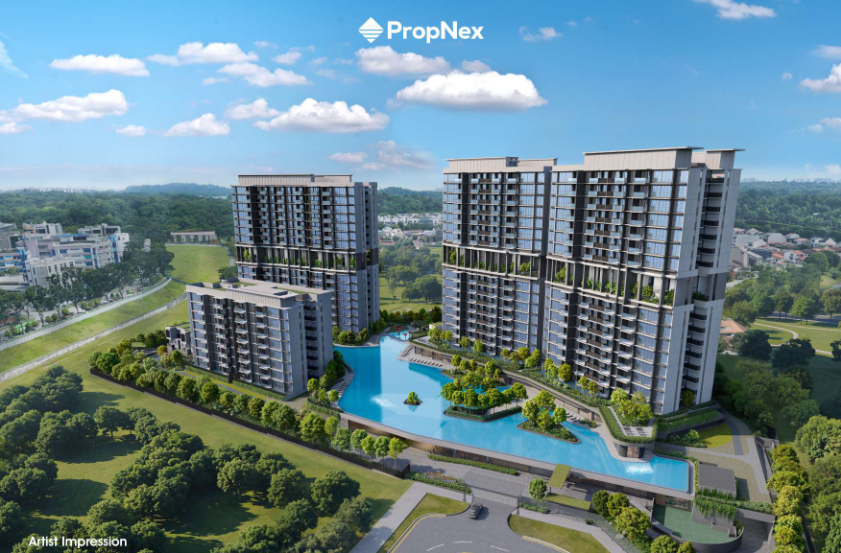
The proposed development occupies the former Thomson View Condominium site on Bright Hill Drive. The 255-unit estate was sold for $810 million to a consortium comprising UOL Group, CapitaLand Development and Singapore Land Group. After land betterment charges and a lease-upgrading premium for a fresh 99-year lease, the land rate works out to $1,178 psf ppr.
The site is approximately 540,314 sq ft and current materials point to approximately 1,268 units. That would make it one of the larger single residential redevelopments in recent years. It is located beside Upper Thomson MRT on the Thomson-East Coast Line, opposite Thomson Plaza and within 1km of Ai Tong School.
There is an important “before” reference point here. In its final years as an approximately 40-year-old estate, Thomson View was reportedly transacting around $1,295–$1,384 psf. This does not tell us what new units will cost, but it illustrates the difference between an ageing resale estate and a newly regranted 99-year redevelopment with a substantially higher land-cost basis.
Why AMO Residence is a close precedent
The most relevant comparison is not simply another project in the wider area. It is AMO Residence, because it involves a similar land-cost range, the same District 20 corridor and a closely related developer pairing.
In 2021, UOL Group and Singapore Land Group, together with Kheng Leong, acquired the Ang Mo Kio Avenue 1 site for $381.4 million. The land rate was about $1,118 psf ppr, compared with Thomson Reserve’s $1,178 psf ppr. AMO Residence launched in 2022 at an average of $1,890 psf, with two-bedroom homes from $1.26 million and three-bedroom homes from $1.81 million.
According to the supplied analysis, AMO Residence resale averaged $2,519 psf over the preceding 12 months, with transactions between $2,359 and $2,647 psf. On those figures, its launch average was roughly 70% above land cost, while the reported resale average is roughly 33% above its launch average.
The comparison is useful because it demonstrates an actual local development pathway: a land purchase, a launch and then subsequent resale evidence. It does not mean Thomson Reserve will repeat the same percentage relationship. Construction costs, financing conditions, product design, unit sizing, market conditions and the eventual sales strategy can all change the final equation. Buyers should regard AMO Residence as a benchmark for questions to ask, not a template for a promised outcome.
A corridor where age shows up in price
The supplied transaction summary for the Bishan, Ang Mo Kio and Upper Thomson corridor shows a simple pattern: newer projects have generally been transacting at higher psf levels than older ones.
| Project | TOP | Units | 12-month average psf | Reported range |
|---|---|---|---|---|
| Thomson Grand | 2015 | 361 | $1,809 | $1,659–$1,909 |
| Thomson Impressions | 2019 | 288 | $1,810 | $1,793–$2,342 |
| Jadescape | 2023 | 1,206 | $2,327 | $1,856–$2,620 |
| AMO Residence | 2026 | 372 | $2,519 | $2,359–$2,647 |
Thomson Grand, at about 11 years old in this comparison, sits nearly $700 psf below the reported AMO Residence average. The gap should not be read as an automatic premium for every new project. Individual transactions vary by unit type, floor, facing, condition and timing. Still, it provides important context: Thomson Reserve would enter a mature residential corridor where buyers already have real, transacted resale references across several ages and project scales.
Jadescape is especially useful as a scale comparison. It was also an ageing estate—Shunfu Ville—acquired en bloc and redeveloped by a consortium into a large project of 1,206 units. Its reported acquisition land rate was $747 psf ppr, it launched at about $1,500–$1,800 psf in 2018–19, and it now averages $2,327 psf in the supplied data. Thomson Reserve’s land cost is higher, so the comparison underscores why buyers should assess its eventual pricing against both its cost basis and the resale alternatives available at launch.
What large scale means for buyers
A project with approximately 1,268 homes can offer depth: more extensive facilities, a wider mix of household types and, over time, a potentially liquid resale market. For owner-occupiers, it may also create a genuine neighbourhood within the development rather than a small boutique proposition.
Scale has trade-offs. A larger number of units can mean a longer sales runway, and buyers may face more competing choices at launch. Later, owners could be selling alongside more neighbours with similar unit configurations. The practical question is not whether a large project is inherently good or bad. It is whether the unit chosen has a clear place within the project’s eventual mix: layout efficiency, orientation, stack, level, noise exposure and proximity to facilities will matter alongside headline psf.
A disciplined checklist before the October preview
Three items deserve careful verification once official materials become available.
-
Confirm the approved development details. Current materials mark the approximately 1,268-unit count and a 2.1 plot ratio as subject to change. Buyers should wait for URA approval and official sales documents before treating these as final.
-
Understand the school claim accurately. Being within 1km of Ai Tong School is a location advantage. However, any enrolment advantage is subject to the standard MOE Phase 2B/2C balloting process that applies to eligible addresses within 1km; it is not a project-specific priority.
-
Test the location personally. The site is beside Upper Thomson MRT, so “doorstep” access is directionally reasonable. Exact walking times, however, depend on the eventual entrance, the relevant station exit and an individual’s pace. Walk the route, including in wet weather or at the time of day that matters to your household.
When official pricing arrives, add a fourth check: compare the actual quantum, not just the psf, with suitable resale alternatives. A compact new unit and a larger resale home can serve very different needs even when their total budgets overlap.
Bottom line
Thomson Reserve is not arriving in an untested location. The Upper Thomson and wider District 20 corridor has established transaction evidence across older and newer projects, while AMO Residence offers a particularly instructive developer-and-land-cost precedent. The $1,178 psf ppr land cost explains why pricing discussions are attracting attention, but it cannot substitute for an official price list.
For now, the soundest approach is to keep the project’s strengths—MRT adjacency, mature amenities, family appeal and redevelopment scale—alongside the unknowns. Treat every pre-preview price as unconfirmed, verify approvals and final specifications, and judge the eventual launch terms against real alternatives. All figures discussed here are based solely on the supplied July 2026 analysis and are subject to change as official information is released.
Disclaimer
This information is provided solely on a goodwill basis, and does not relieve parties of their responsibility to verify the information from the relevant sources and/or seek appropriate advice from relevant professionals, such as valuers, financial advisors, bankers and lawyers. For avoidance of doubt, PropNex Realty Pte Ltd, and its salesperson, accepts no responsibility for the accuracy, reliability, and/or completeness of the information provided. Copyright in this publication is owned by Sebastian Teo, and this publication may not be reproduce or transmitted in any form, or by any means in whole, or in part, without prior written approval.