
Singapore families have long treated the 1km school-distance rule as a major factor when choosing a home. That approach made sense when living within 1km could provide a meaningful advantage during a competitive Primary 1 ballot. However, the Ministry of Education’s revised framework changes how distance works for selected schools from the 2027 P1 Registration Exercise.
The practical message for buyers is simple: school proximity still matters, but the old assumption that every metre closer automatically creates a better admission position is no longer reliable. A home search should now consider the full registration framework, the school’s track, citizenship priority, balloting risk, transport, daily liveability and the property’s long-term value.
What changes from the 2027 P1 registration exercise?
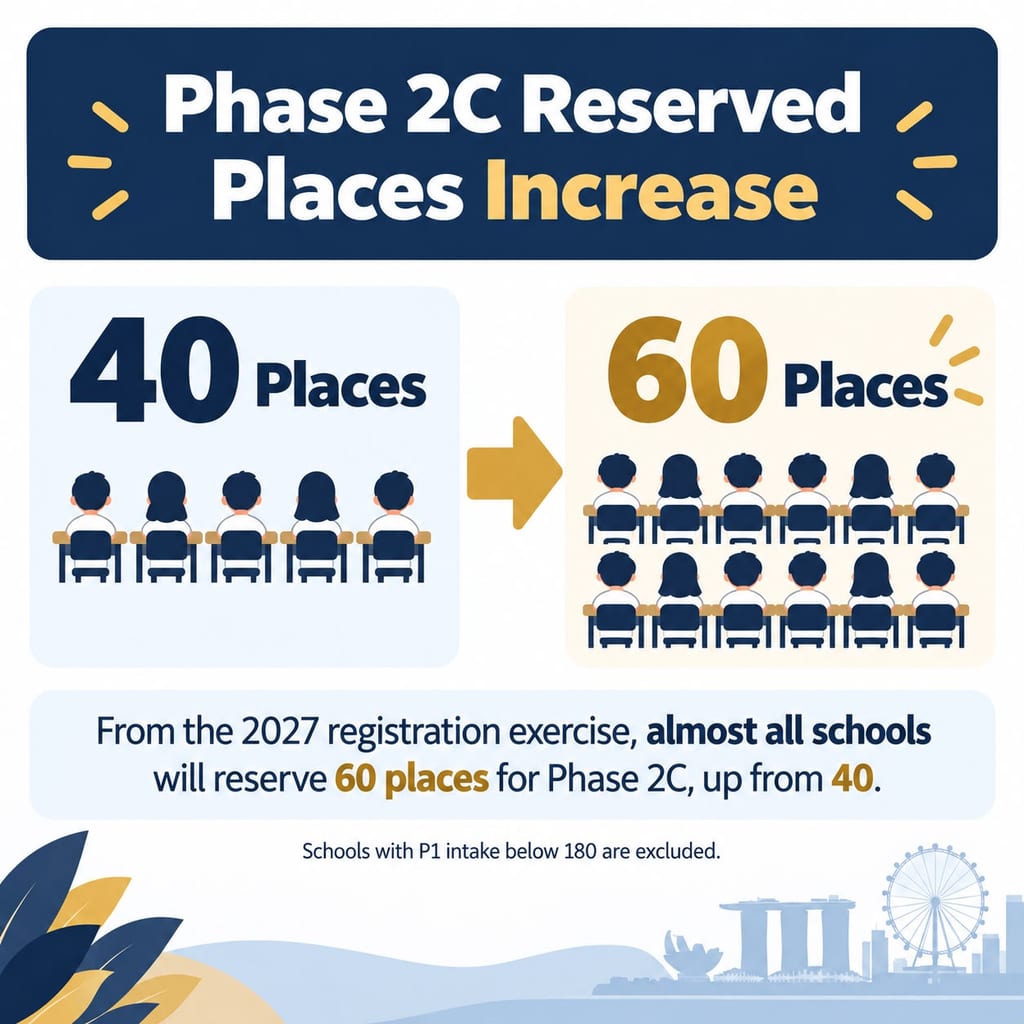
The revised rules apply to children starting Primary 1 in 2028. In most schools, Phase 2C reserved places will increase from 40 to 60. Phase 2C is the open-access phase for children without prior connections to the school, so the increase is intended to create more opportunities for families who do not have sibling, alumni, staff or community links.
Schools with smaller Primary 1 intakes are excluded from the increase. The Straits Times has reported that this means schools with intakes below 180 pupils, while families should still verify the current position using official MOE information when planning an application.
The earlier registration phases remain important. Phase 1, Phase 2A and Phase 2B continue to operate ahead of Phase 2C, and eligible applicants in those phases retain priority. In other words, the additional Phase 2C places do not make distance irrelevant across the entire registration system; they change the opportunity set for families applying in Phase 2C.
The new two-track scheme for 12 schools
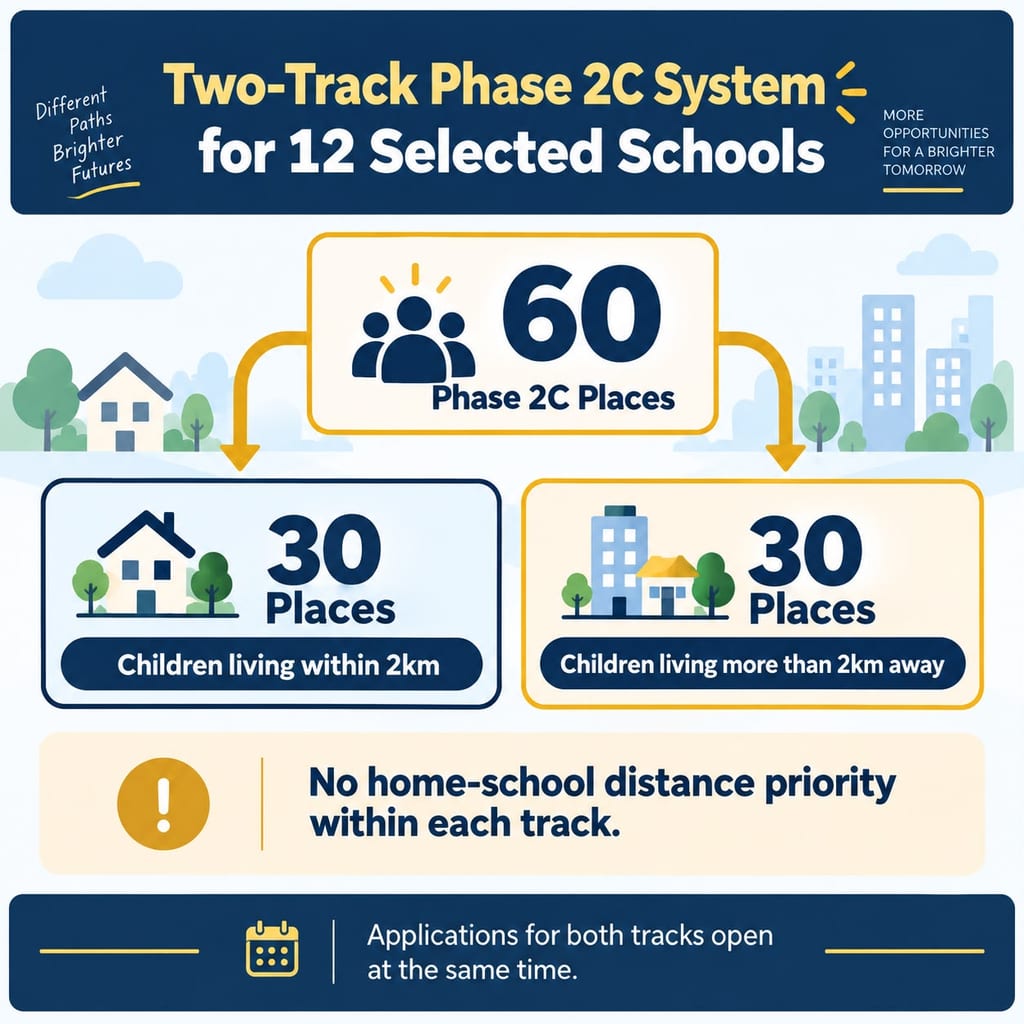
At 12 schools in neighbourhoods where public housing accounts for less than 40% of dwelling units within 2km, the 60 Phase 2C places will be divided equally:
- 30 places for children living within 2km; and
- 30 places for children living beyond 2km.
Applications for both tracks open at the same time. Within each track, there is no additional home-school distance priority. If Singapore Citizen applicants exceed the available places, balloting will be conducted. Singapore Citizens continue to have priority over Permanent Residents, and unused places in one track can flow to Singapore Citizen applicants in the other track.
The 12 schools are Anglo-Chinese School (Junior), Anglo-Chinese School (Primary), CHIJ (Katong) Primary, Methodist Girls’ School (Primary), Nanyang Primary School, Ngee Ann Primary School, Pei Hwa Presbyterian Primary School, Raffles Girls’ Primary School, Singapore Chinese Girls’ Primary School, St. Margaret’s School (Primary), Tanjong Katong Primary School and Tao Nan School.
Why living within 1km may no longer be decisive
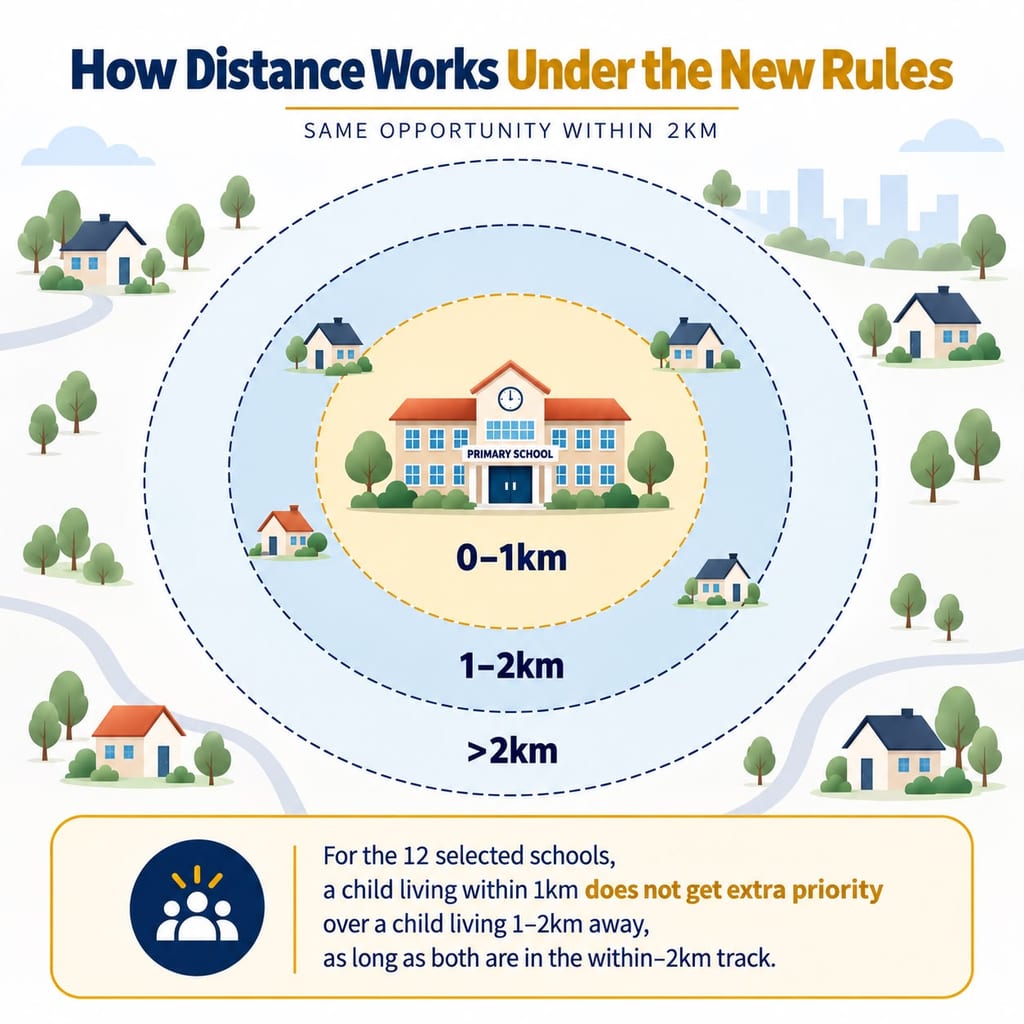
Under the two-track arrangement, a child living 800 metres from a selected school and another living 1.8km away are both in the within-2km track. Neither receives extra distance priority over the other within that track. If applications exceed the 30 places, the outcome can depend on balloting rather than the difference between those two addresses.
This does not mean that the two homes are equally convenient. The closer address may offer a shorter walk, easier school-day logistics and less exposure to rain or traffic. Those lifestyle benefits can be valuable every weekday for six years. But they should not be confused with a guaranteed admissions advantage.
Similarly, a home more than 2km away is not automatically out of consideration at the 12 schools. It may fall within the dedicated beyond-2km track. That widens the geographic area families can consider, particularly if a preferred school is located near a district where suitable housing is limited or expensive.
What this means when choosing a property
1. Verify the official distance, rather than relying on marketing language
A listing may describe a school as “nearby” or quote a straight-line distance, but P1 registration uses the official home-school distance methodology. MOE directs parents to OneMap’s school-distance tool. Buyers should check the exact address, development and school before making a decision, and should remember that eligibility can depend on the registration year and the rules then in force.
2. Separate admission probability from everyday convenience
Ask two separate questions: does this home fall into the relevant registration track, and is it genuinely convenient for the family? A home at 1.2km may now offer the same Phase 2C distance position as one at 0.8km for a selected school, while still being materially different in walking time, route safety, childcare arrangements and transport costs.
3. Compare the entire shortlist, not only one school
Families should identify realistic alternatives in the surrounding area. Compare school routes, after-school activities, childcare availability, MRT and bus access, groceries, parks and the time needed for parents to commute. A property that supports the family’s full routine may be a better choice than one purchased solely to cross an old 1km mental threshold.
4. Test the financial trade-off
Paying a substantial premium for a smaller home or less suitable layout purely to move from 1.2km to 0.9km may not be sensible when the admission advantage is no longer present within the same track. Consider cash flow, renovation, maintenance, resale demand and the possibility that your child may ultimately attend another school.
5. Keep policy timing in mind
The framework begins with the 2027 registration exercise, and MOE will periodically review the list of schools under the two-track scheme. Housing profiles and school policies can change. A purchase decision should therefore be based on verified current rules, not a promise that a particular distance will remain advantageous throughout the ownership period.
A better home-search checklist
Before committing to a property, shortlist the schools that genuinely suit your child, check each address on OneMap, identify the applicable registration phase and citizenship category, and review recent balloting information where available. Then inspect the actual daily route at the times your family would use it. Finally, compare the home on normal property criteria: price, tenure, size, condition, transport, facilities and resale flexibility.
The new Phase 2C framework is designed to widen access and encourage a broader social mix while preserving a dedicated within-2km track. For families, that means a more balanced decision is possible. School proximity remains relevant—but the strongest purchase is likely to be the home that combines sensible admission planning with a practical, financially sustainable and enjoyable everyday life.
Policy note: This article summarises the MOE announcement dated 10 September 2026 and related reporting. Parents should confirm the latest registration rules and distance calculation with MOE before relying on them for a purchase or application.
Disclaimer
This information is provided solely on a goodwill basis, and does not relieve parties of their responsibility to verify the information from the relevant sources and/or seek appropriate advice from relevant professionals, such as valuers, financial advisors, bankers and lawyers. For avoidance of doubt, PropNex Realty Pte Ltd, and its salesperson, accepts no responsibility for the accuracy, reliability, and/or completeness of the information provided. Copyright in this publication is owned by Sebastian Teo, and this publication may not be reproduce or transmitted in any form, or by any means in whole, or in part, without prior written approval.