Summary
Singapore’s new private-home market regained momentum in July 2026 after an exceptionally quiet June, with the return of fresh launches giving buyers more meaningful choices. Developers sold 731 new private homes excluding Executive Condominiums (ECs), up from 156 in June. The month was driven chiefly by two launches at different ends of the market: Lentor Gardens Residences in the Outside Central Region (OCR) and Dunearn House in the Core Central Region (CCR).
The headline is encouraging, but buyers should read it carefully. July was a launch-led rebound rather than proof that every project will sell equally well. The results underline the continuing importance of location, available supply, unit mix and, above all, the total purchase price. For households comparing an apartment Singapore price, the S$2.5 million threshold remained a useful marker of affordability.
Key information at a glance
- 731 new private homes, excluding ECs, were sold in July 2026—368.6% higher than June’s 156 units.
- Developers launched 889 private homes after no new private units were launched in June; the July sales-to-launch ratio was about 82.2%.
- Year-to-date sales from January to July were 4,885 units, still 11.6% lower than the same period in 2025.
- The OCR led sales with 334 units (45.7%), followed by the CCR with 235 units (32.1%) and the RCR with 162 units (22.2%).
- Lentor Gardens Residences sold 270 of its 499 units at a median S$2,357 psf.
- Dunearn House sold 212 units at a median S$3,111 psf; 250 units were released during the month, implying take-up of roughly 84.8% of released supply.
- 58.1% of July’s new non-landed private-home transactions were below S$2.5 million.
- Singaporeans accounted for 87.5% of new non-landed private-home purchases excluding ECs in July.
The rebound was mainly about supply returning
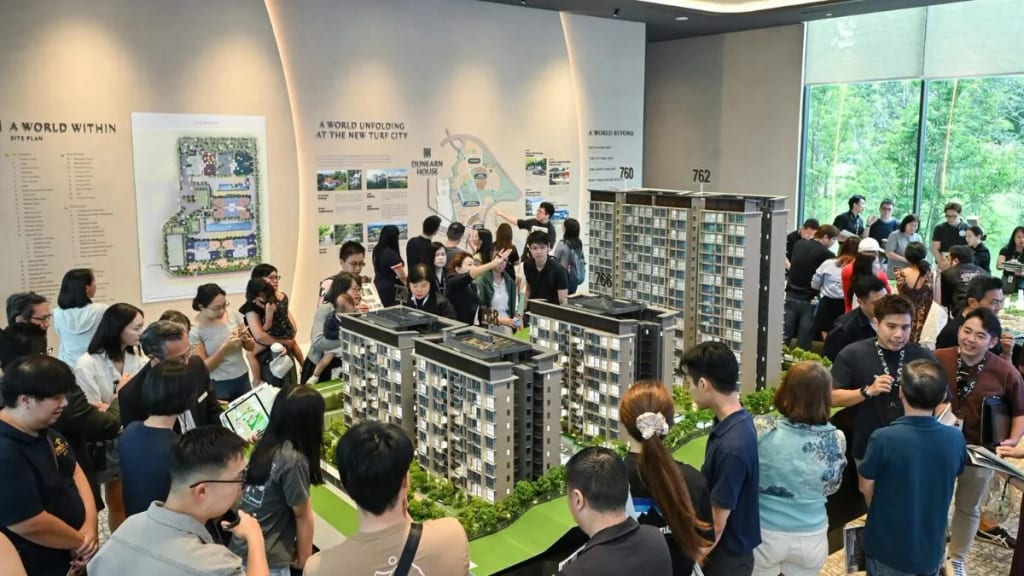
June was unusual because developers did not launch a single new private home. Against that low base, July’s 731 sales naturally looks dramatic. Yet the more instructive number is the 889 units launched. Buyers had new options to evaluate, and developers had fresh inventory that could be marketed with a clear proposition.
The sales-to-launch ratio of about 82.2% shows substantial absorption, but it also means not every new unit was immediately taken up. That is normal and healthy: purchasers continue to compare stacks, layouts, financing and alternatives rather than simply buying because a project is new. For anyone looking at a private apartment in Singapore, this is a reminder to treat a strong launch month as a starting point for due diligence—not a reason to rush into an unsuitable unit.
The broader context matters as well. January-to-July new-home sales remained below the corresponding 2025 total. A single strong month narrows a gap, but does not erase the differences in supply timing and buyer decisions across the year.
Two very different projects shaped July’s result
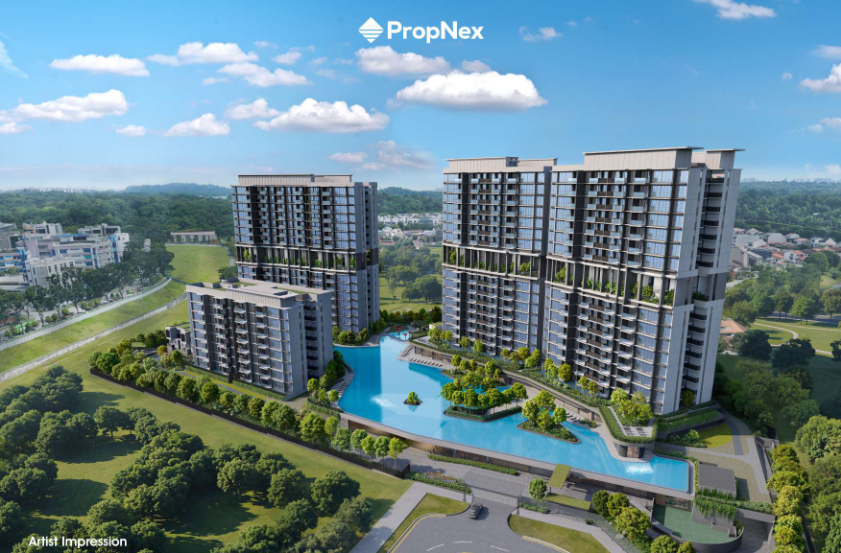
The OCR accounted for the largest share of July sales, led by Lentor Gardens Residences. The 499-unit project recorded 270 sales at a median S$2,357 psf. Its performance is notable because it is the seventh major launch in the wider Lentor Hills precinct. However, much of the new supply at earlier projects had already been absorbed, reducing direct competition from unsold stock.
For buyers considering District 26: Upper Thomson, Mandai and Springleaf, the takeaway is not simply that Lentor is popular. It is that precinct maturity, transport access and a realistic purchase quantum can work together. The project also had many transactions under S$2.5 million, showing how unit sizing can make a newly launched home accessible to a wider group even where psf pricing has risen.
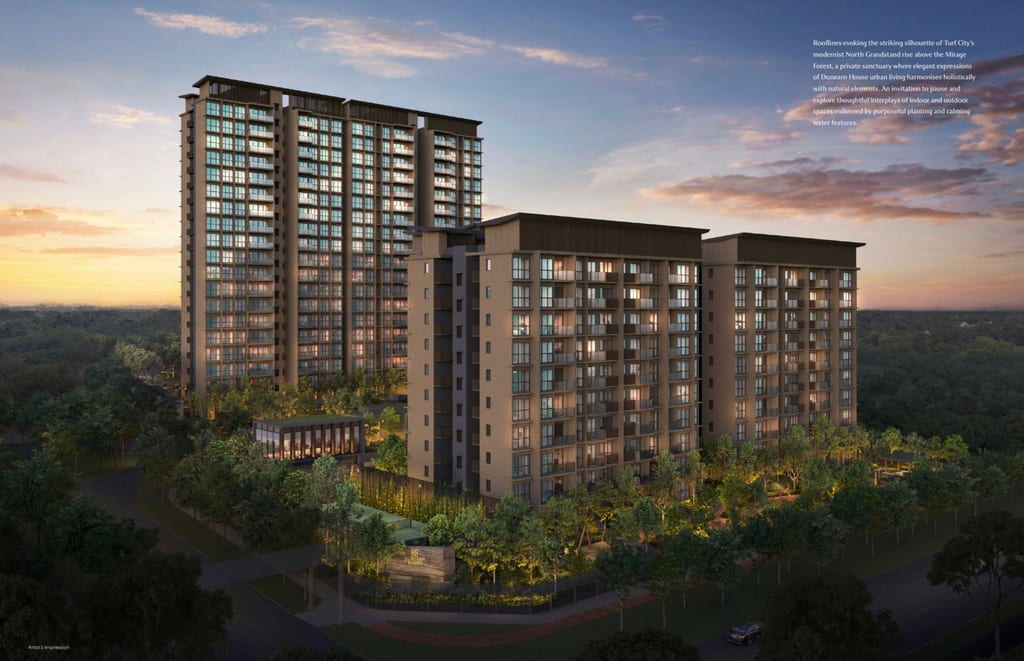
At the prime end, Dunearn House generated most of the CCR’s recovery. It recorded 212 sales at a median S$3,111 psf and accounted for about nine in 10 CCR developer sales during the month. It is the first new private residential development in the upcoming Bukit Timah Turf City precinct, so it gave buyers a new reference point for an emerging location.
Its example is especially useful when assessing apartment price in Singapore. A higher psf figure does not tell the whole affordability story. About 42.5% of Dunearn House’s July transactions were below S$2.5 million, supported by smaller unit sizes. Buyers should therefore assess both the quantum they must fund and whether the home’s size genuinely suits their household over the intended holding period.
Why the S$2.5 million threshold still matters
In July, 58.1% of new non-landed private homes sold below S$2.5 million. The share for January through July was 61.6%, compared with 66.4% in 2025. This gradual decline does not automatically mean buyers are becoming less sensitive to price. Higher development costs may make it harder for developers to keep a large proportion of units under a familiar budget ceiling.
The practical implication is to separate psf price from total quantum. Psf helps compare efficiency and location, but buyers commit to the full price, down payment, stamp duties and monthly loan. A compact two-bedroom unit may sit below S$2.5 million while a larger family layout in the same project may not. Conversely, choosing a smaller home solely to meet a number can create costly compromises later if a family needs an additional bedroom or workspace.
Before booking a unit, a buyer can apply a simple four-part check:
- Budget for the complete commitment. Include the purchase price, Buyer’s Stamp Duty, legal costs, renovation, furnishings and a sensible reserve.
- Stress-test the mortgage. Check whether instalments remain manageable if rates or household circumstances change.
- Compare like with like. Consider usable space, bedroom configuration, facing, proximity to transport and remaining supply—not just headline psf.
- Match the unit to the holding plan. An owner-occupier’s priorities may differ from an investor’s, and a short-term upgrade plan may call for different trade-offs from a long-term family home.
Demand was broader than the two headline launches
Although Lentor Gardens Residences and Dunearn House accounted for a large share of sales, activity was not limited to them. The Rest of Central Region (RCR) nearly doubled sales from June despite lacking a comparable major launch. Buyers continued to select units from projects already in the market, including Union Square Residences, Hudson Place Residences, One Marina Gardens and The Continuum.
That distinction matters. It suggests that buyer demand can remain active where a project’s location and offering are aligned, even without a launch-week spotlight. It also reinforces why prospective purchasers should compare currently available stock as well as new releases. A project already selling down may have a unit, orientation or completion profile that better meets a buyer’s needs.
Local buyers remain central to the market
Singaporeans represented 87.5% of July’s new non-landed private-home purchases excluding ECs. Even in the CCR, Singaporeans made up 83.4% of transactions, while Permanent Residents represented 13.6%. This local participation is a useful signal that owner-occupier and local upgrader considerations remain important to developers’ unit mix and pricing strategies.
For households, the lesson is to focus on personal affordability and suitability rather than broad narratives about overseas demand. The strongest July projects succeeded by pairing a location story with unit choices and price quantums that local buyers could evaluate within their own financing limits.
What to watch next
The source expects August activity to ease because fewer major launches are scheduled and the Seventh Lunar Month may contribute to a quieter period. More launches are anticipated from mid-September. A softer August figure, if it occurs, should therefore be understood alongside the launch calendar rather than viewed in isolation.
For buyers, the best response is preparation. Obtain an in-principle loan assessment, clarify your all-in budget, shortlist preferred districts and review available units before the next launch cycle. July’s data shows that well-positioned projects can attract healthy take-up, but it also shows why careful comparison is essential. The right purchase is not defined by the busiest launch weekend; it is the home whose location, layout, price quantum and timing fit your own plan.
Source: 99.co, “New home sales rebound to 3-month high as July launches return”, published 17 August 2026.
<small> <strong>Disclaimer</strong><br> This information is provided solely on a goodwill basis, and does not relieve parties of their responsibility to verify the information from the relevant sources and/or seek appropriate advice from relevant professionals, such as valuers, financial advisors, bankers and lawyers. For avoidance of doubt, PropNex Realty Pte Ltd, and its salesperson, accepts no responsibility for the accuracy, reliability, and/or completeness of the information provided. Copyright in this publication is owned by Sebastian Teo, and this publication may not be reproduce or transmitted in any form, or by any means in whole, or in part, without prior written approval. </small>